


 United Arab Emirates
 Saudi Arabia


Educators, schools, and parents have long tried different strategies to make classrooms and lessons more engaging for students. From colourful charts and interactive board games to animated videos and VR experiences, there have been different approaches to help students have a better experience in classrooms.
LEGO Education arose from the same place: to give students a better classroom experience and keep them engaged while learning complex concepts.
But how are these LEGO kits any different from other regular toys or games, or diagrams that educators have used in their classrooms? Do they offer more for students or schools in terms of learning outcomes or student engagement?
In this article, we aim to explore these questions.
What is LEGO Education?
LEGO Education is a series of kits based on LEGO bricks designed to help students learn complex subjects and topics as they build fun and interactive models. These kits are designed by child education experts to be aligned with various educational standards, such as Next Generation Science Standards and Common Core State Standards.
Most LEGO Education Kits, or the most popular kits, are designed for STEM (Science, Technology, Engineering, and Maths) education, but there is also significant emphasis on helping kids develop their social skills. Particularly in classroom settings, these kits have been shown to help improve social skills, oral communication skills, and collaboration skills.
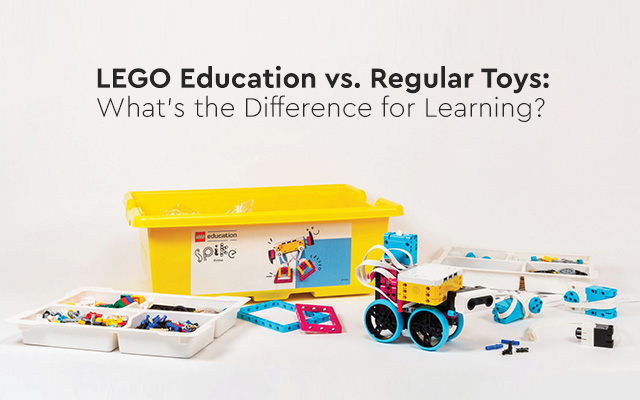
For instance, the LEGO Spike Essential kit is meant largely to teach kids coding and robotic skills. But the lesson plans include minifigures with relatable personalities and revolves around storytelling. This holistic approach allows kids to learn both technical and social skills.
While kids can use these kits on their own, they were designed as complete classroom solutions with resources for teachers and educators to get the best results. These kits are also designed so that students can play around with them individually or in groups. Besides the bricks, motors, and sensors that come in the box, these kits have dedicated online portals for teachers with detailed lesson plans, curricula, and tools for measuring learning outcomes.
How are LEGO Education tools designed?
Lego Education tools are designed based on the Learning Through Play concept. Learning Through Play is a widely studied approach to education and is based on the idea that children learn best when they’re having fun. This is also a much more holistic approach to education; instead of focusing solely on the cognitive development of a child, Learning Through Play also places emphasis on their creative, emotional, social, and physical development.
There are five features that characterise Learning Through Play:
- The child experiences that activity as joyful.
- The child finds the activity meaningful.
- The activity involves active and engaging participation.
- Involves iterative thinking (experimentation, testing, etc.)
- Involves social interaction.
The Learning Through Play approach also aims to transform children into lifelong learners.
The current generation of LEGO Education solutions are in-part built on the work of MIT professor Seymour Papert in collaboration with LEGO. Papert had developed LOGO, a programming language for kids, and, along with MIT Media Lab, developed programmable LEGO kits.
LEGO Education also employs the 5E Model of Instruction (Engage, Explore, Explain, Elaborate, and Evaluate), the evidence-based model used by teachers worldwide.
What is the difference between LEGO Education and regular toys?
Toys, in general, are good for helping children learn new skills and to navigate the world around them. They encourage children to be curious, explore, experiment, activate, and interact with others. But for most toys, the focus is on the child having fun and staying engaged. Any learning or skill development that happens is a bonus.
Most toys are also designed with a focus solely on kids. Particularly for older kids, there are very few toys that parents or teachers could use as a tool for interacting with children.
On the other hand, LEGO Education kits are designed both for kids to play with and at the same time learn with. Both playing and learning go hand in hand with LEGO Education kits.
LEGO Education kits are also designed to aid teachers and educators. They come with detailed lesson plans aligned with teaching and curriculum standards across the world and can significantly reduce the workload for teachers while enhancing engagement among kids and improving learning outcomes.
Another major difference between regular toys and LEGO Education kits is that very few toys are designed for kids to work together to achieve a goal. There are many toys that encourage kids to compete with each other, but very few that encourage cooperation. LEGO Education kits can be used alone by students or in groups in a classroom. These kits are designed for children to work together and build teamwork skills as they go through the lessons.
|
Regular Toys |
LEGO Education Kits |
|
Designed only for fun and keeping kids engaged |
Designed for kids to learn while playing |
|
Designed only with kids in mind |
Designed for kids and to enable educators |
|
Not aligned with curriculums or standards |
Aligned with recognised standards and curriculums |
|
Built for individual play |
Built for kids to play in groups or as individuals |
How can LEGO Education tools help educators?
LEGO Education tools enable educators to offer a better classroom experience for their students. These kits have been proven to enhance student experience and improve learning outcomes across all age groups.
Besides this, every LEGO Education kit comes with a lot of resources for educators and teachers. These include complete lesson plans to use the kit with and tests to evaluate their students once the lessons are completed.
Are LEGO Education tools better for kids compared to regular toys?
Yes. Unlike regular toys, LEGO Education offers guaranteed learning outcomes. These kits will help your kids learn advanced concepts through hands-on learning experiences. These kits can help your kids understand how the theories and concepts they learn in classrooms and in their textbooks work in real-life.
LEGO Education tools are essentially very fun and interactive textbooks that your kids can’t get enough of.
Check out our highly curated collection of learning solutions from LEGO Education
